
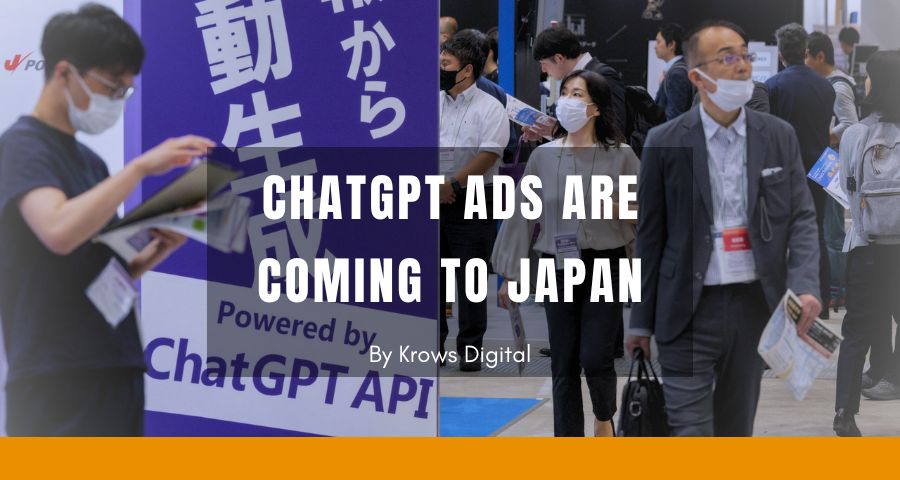
A new advertising channel is about to open inside one of the tools Japanese consumers already use every day to ask questions, compare options, and make decisions. On May 7, 2026, OpenAI confirmed it will expand its ChatGPT advertising pilot to Japan, along with the UK, South Korea, Brazil, and Mexico, in the coming weeks. This follows the May 5 launch of OpenAI's self-serve Ads Manager in the US, which gives businesses a way to buy and manage ChatGPT ad campaigns directly.
For brands operating in Japan, this is not a distant US story. ChatGPT already has the highest usage rate among active generative AI users in Japan, and the country was specifically named as one of the next markets. That combination makes this worth understanding now, before the rollout reaches Japanese users and the early-mover advantage disappears.
This article explains what changed, why Japan matters in this rollout, what the platform actually does, and what foreign and Japan-based brands should do to prepare without overreacting to an unproven channel.
What actually changed
ChatGPT advertising moved from a closed, expensive pilot to something far closer to the platforms marketers already use. According to Search Engine Journal, the May 5 update introduced a beta self-serve Ads Manager, cost-per-click bidding alongside the existing impression-based model, and expanded measurement tools including a pixel and a Conversions API.
The structural details matter for anyone who runs paid media. As reported by PPC Land, campaigns use a three-level hierarchy of campaign, ad group, and ad, which mirrors the architecture of Google Ads and Meta. The biggest difference is targeting: instead of selecting keywords, advertisers write natural-language "context hints" describing the kinds of questions or situations a user might bring to ChatGPT. That is a different skill from keyword research, but conceptually closer to the audience-signal approach performance marketers already use with broad match.
A few days after the self-serve launch, OpenAI confirmed the international expansion. The Japan inclusion was disclosed by OpenAI's VP of Monetization in a public post, as covered by PPC Land, confirming the pilot will run only on the Free and Go tiers while Plus, Pro, Business, Enterprise, and Edu users continue to see no ads.
Why Japan matters in this rollout
Japan was not added at random. According to a Japan Research Center survey reported by The Egg, generative AI adoption in Japan more than doubled in a single year, rising from 19% in December 2024 to 45% by December 2025. Among active generative AI users, ChatGPT holds the highest usage rate at 37%, ahead of Gemini at 30% and Copilot at 17%. ChatGPT is so culturally embedded that it has a Japanese nickname, "Chappie," which was even nominated for a buzzword of the year award.
That adoption curve is why Japan was named among the most attractive expansion markets, alongside the UK and Brazil, due to high online advertising intensity and a large ChatGPT audience. For brands in Japan, this means a meaningful and growing share of buyers are already asking an AI assistant the kinds of comparison and research questions that used to happen on Google or Yahoo! JAPAN.
There is an important nuance, though. The pilot only serves ads to Free and Go users, while paid tiers stay ad-free. In a B2B context, decision-makers and professionals are more likely to be on paid plans, which means ChatGPT ads may reach a more consumer-leaning audience first. We will return to what that means for targeting below.
What foreign brands often misunderstand
The first misunderstanding is treating this as a reason to chase a new channel before it is proven. ChatGPT ads in Japan are not even live yet at the time of writing, and the format is still in beta where it has launched. The disciplined move is to prepare, not to divert budget from channels that are already producing results.
The second misunderstanding is assuming ChatGPT ads work like search ads. They do not. The targeting is contextual and conversational, not keyword-based, and the ads appear inside a decision-making conversation rather than next to a list of links. This means creative and messaging need to fit the moment a user is actively comparing options or asking for a recommendation, not interrupting passive browsing.
The third, and most important for Japan, is confusing paid visibility inside ChatGPT with organic visibility inside AI answers. These are two separate things. ChatGPT ads are a media buy. Being recommended or cited inside an AI-generated answer is an organic outcome that depends on how clearly your brand, content, and entity information are structured. For most brands in Japan, the organic side, often called AEO or GEO, matters more in the long run than the ad placements, because it shapes whether AI tools mention you at all. We cover that in detail on our AEO/GEO services page.
Practical strategy recommendations
For brands in Japan, here is how we would approach the ChatGPT ads rollout without overcommitting.
Get your measurement foundation ready first. The new ChatGPT pixel and Conversions API only create value if your tracking is already clean. If your GA4, Google Ads conversion tracking, and Meta Pixel and Conversion API setups are inconsistent, adding a fourth source will produce confusion rather than insight. Fix the foundation before testing a new channel.
Treat ChatGPT ads as a controlled experiment, not a budget shift. When the pilot reaches Japan, the sensible approach is a small, ring-fenced test budget with clear success criteria, run alongside your existing Google, Meta, and LINE/Yahoo activity. Do not pull spend from channels that are already converting in order to chase an unproven format.
Match the channel to the right audience. Because ads serve to Free and Go users and not paid tiers, ChatGPT ads may fit consumer and high-consideration purchases better than senior B2B targeting in the early phase. A consumer wellness brand or an e-commerce product has a more natural fit here than a service aimed at enterprise decision-makers who are likely on ad-free plans.
Prioritize the organic AI-visibility work in parallel. Whether or not you test the ads, the bigger structural shift is that Japanese consumers are increasingly asking AI tools for recommendations. Making sure your brand is clearly described, well-structured, and credible enough to be surfaced inside AI answers is work that compounds over time and does not depend on a beta ad product.
Channel-specific implications
For ChatGPT ads specifically, the early opportunity is lower competition and lower cost while the format is new, paired with the risk that the audience and measurement are still maturing. Early testers gain platform-specific creative experience and optimization data before competition increases, which is a real advantage if you have the budget to experiment without disrupting core channels.
For Google Ads, ChatGPT ads do not replace search intent capture. High-intent search remains one of the most reliable channels in Japan, and brand search stays valuable as a low-cost source of qualified conversions when consumers cross-check a brand they discovered elsewhere.
For Meta and LINE/Yahoo, the role is unchanged in the short term. Meta builds familiarity and retargeting, and LINE/Yahoo remains essential for Japan-local reach. ChatGPT ads, if they perform, would slot in as an additional upper-to-mid-funnel channel rather than a replacement for any of these.
For SEO, AEO, and GEO, this is the channel most directly affected by the underlying trend. As more Japanese users research and compare inside AI tools, the organic question of whether AI assistants mention your brand becomes a core visibility issue, not a niche concern.
Common mistakes to avoid
Three mistakes are predictable when a high-profile channel like this launches.
Rushing in with a large budget before the format is proven in Japan. Beta channels reward small, structured tests, not big bets.
Cutting working channels to fund the experiment. The cost of testing ChatGPT ads should come from a dedicated experimentation budget, not from campaigns that are already producing revenue.
Confusing ads with organic AI visibility. Buying ChatGPT ad placements does nothing to ensure AI tools recommend you organically. These require separate work, and for most brands the organic side has longer-lasting value.
How Krows Digital helps
We help foreign brands entering Japan, and Japan-based businesses targeting international audiences, build acquisition systems that reflect how the Japanese market actually works. As AI tools like ChatGPT become part of how consumers research and decide, we help clients prepare on two fronts: testing new paid channels in a controlled, measurement-first way, and strengthening organic visibility inside AI answers through AEO and GEO work.
If you want to understand how the ChatGPT ads rollout could affect your category in Japan, or how to make your brand more visible inside AI search, we can help you build a practical plan before the channel goes live.
FAQ
When will ChatGPT ads be available in Japan?
OpenAI announced on May 7, 2026 that it will expand its ChatGPT advertising pilot to Japan, along with the UK, South Korea, Brazil, and Mexico, in the coming weeks. A specific Japan launch date had not been confirmed at the time of writing.
Who sees ChatGPT ads?
Ads are served only to users on ChatGPT's Free and Go tiers. Plus, Pro, Business, Enterprise, and Edu users continue to see no ads. This matters for targeting, since many B2B decision-makers may be on ad-free paid plans.
How is ChatGPT ad targeting different from Google Ads?
Instead of selecting keywords, advertisers write natural-language context hints describing the kinds of questions or situations a user might bring to ChatGPT. The campaign structure of campaign, ad group, and ad is familiar, but the targeting logic is contextual and conversational rather than keyword-based.
Should we move budget into ChatGPT ads now?
Not as a budget shift. The sensible approach is a small, ring-fenced test budget with clear goals, run alongside existing Google, Meta, and LINE/Yahoo activity, rather than pulling spend from channels that are already converting.
Is buying ChatGPT ads the same as showing up in AI answers?
No. ChatGPT ads are a paid media buy. Being recommended or cited inside an AI-generated answer is an organic outcome that depends on how clearly your brand and content are structured, often called AEO or GEO. The two are separate, and the organic side usually has longer-lasting value.
Does ChatGPT really have a large audience in Japan?
Yes. Among active generative AI users in Japan, ChatGPT has the highest usage rate at 37%, and overall generative AI adoption in Japan rose from 19% in December 2024 to 45% by December 2025, according to Japan Research Center survey data.
Ready to prepare for AI advertising in Japan?
Krows Digital helps foreign and Japan-based businesses adapt their paid ads, SEO, tracking, and content strategy for the Japanese market, including emerging AI channels like ChatGPT ads and visibility inside AI search. Contact us if you want to review your current approach and identify the best next steps for your market.