If you’re marketing in Japan in 2026, the biggest mistake you can make is building a media plan that looks like a “global default”: Google + Meta, then maybe TikTok later.
Japan’s digital ad market is still growing — but where the growth is happening is changing. The spending shift is being pulled in three directions at once:
- Video formats are growing fast
- Retail media is moving from “nice-to-test” to “must-understand”
- Local platform inventory is becoming even more important (especially the LINE/Yahoo ecosystem)
This isn’t theoretical. Dentsu’s reporting on ad spend in Japan shows internet advertising expenditures reached ¥3,651.7B in 2024 (+9.6% YoY), with growth supported by rising demand for video — including vertical video and connected TV. That shift is exactly what you’re seeing in campaign performance today: attention is moving toward video-led experiences, and brands that adapt faster win. See Dentsu’s 2024 Advertising Expenditures in Japan release.
At the same time, Dentsu’s detailed analysis forecasts that in 2025, internet advertising media expenditures would continue expanding, and highlights video advertising maintaining double-digit growth (with video forecast at ¥967.7B, +14.7% YoY). That matters because it signals where budgets and platform innovation are flowing. See Dentsu’s detailed analysis page.
So what does this mean for founders, growth teams, and marketers entering Japan?
It means you need a Japan-first playbook that reflects how the market is evolving — not just a translated version of your U.S./EU strategy.
1) Local platform inventory is becoming more important (not less)
Many foreign brands assume “Japan = Google Search + Instagram.”
But Japan is also a portal + messaging + ecosystem market.
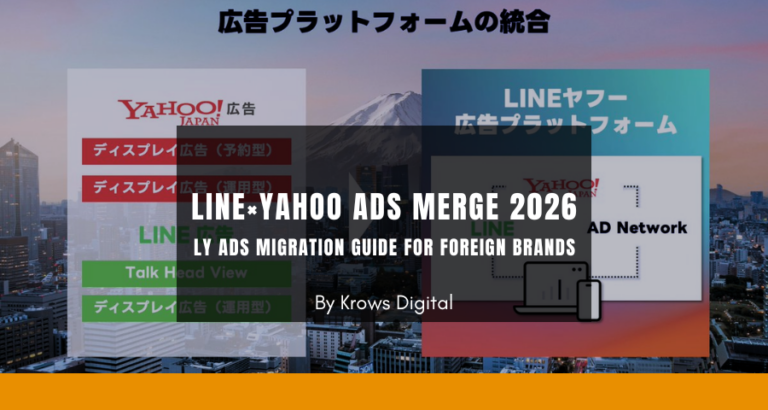
One of the biggest signals of that is the platform consolidation happening inside the LINE/Yahoo universe (LY). LY has officially confirmed it will launch the unified display environment (“LINEヤフー広告 ディスプレイ広告”) on April 1, 2026, as part of the broader ad platform integration. See the official announcement: LINEヤフー for Business (Feb 18, 2026).
The English notice also explains that the “LINE Ads” and “Yahoo! JAPAN Ads Display Ads” systems will be offered as “LY Ads Display Ads” starting in spring 2026, with Yahoo! JAPAN Ads being renamed to LY Ads. See: “Integration of ad platforms” notice.
Why does this matter for ad spend shifts?
Because it shows where “local inventory” is headed: less fragmentation, more consolidated buying, and more incentive for advertisers to consider LY placements as a serious part of reach and retargeting strategy.
What this means in practice
If you’re entering Japan, you should treat local platforms as part of your core plan when:
- you need domestic reach and credibility
- you’re trying to retarget at scale
- you need brand visibility that feels “native” to Japan user behavior
This isn’t about replacing Google or Meta — it’s about building a plan that matches where Japanese users spend attention.
2) Video formats are accelerating because the “where” of viewing changed
Japan’s video growth isn’t just “people like video.”
It’s also about devices: mobile, connected TV, and in-stream environments.
A very practical recent example: LINEヤフー announced it expanded in-stream ads availability to all Yahoo! Ads advertisers, citing increased demand for video ads delivered “naturally” within content viewing contexts and the spread of viewing across devices like connected TV. See the press release: LY Corp (Feb 5, 2026) – Yahoo! Ads in-stream expansion.
This is exactly what “video growth” looks like at the platform level:
- more placements become available
- more inventory becomes purchasable by more advertisers
- more budgets shift from static display to motion formats
What’s driving video performance in Japan right now
In our work across Japan campaigns, the formats that tend to win are:
- short vertical videos with clear subtitles
- calm, trust-first creative (less hype, more proof)
- “show the system” or “show the process” videos
- in-stream cuts that feel like content, not like ads
The brands that struggle are the ones that reuse global ad creatives that don’t fit Japan’s consumption style.
If you’re building a 2026 plan, assume video will not be optional — and build a content system that can produce multiple variants without slow production cycles.
3) Retail media is drawing attention because purchase intent is already there
Retail media is growing globally, but Japan has a specific advantage: strong marketplaces, loyalty ecosystems, and huge e-commerce volume.
Japan’s domestic B2C e-commerce market reached ¥26.1 trillion in 2024 (+5.1% YoY), according to the official METI report release. That number matters because retail media grows naturally when marketplace shopping grows. See: METI – Results of FY2024 E-Commerce Market Survey.
Two of the most important retail media moves for marketers in Japan are:
A) Mercari Ads becoming a real channel
Mercari officially announced it launched “Mercari Ads” (広告事業「メルカリAds」) inside the Mercari app, enabling advertisers to reach users in a marketplace environment. See the official Mercari announcement: Mercari press release (Feb 6, 2025).
Mercari also publishes ongoing updates about the product and feature evolution after launch. Example: Mercari Ads Updates (Sep 9, 2025).
B) Rakuten’s ecosystem keeps pushing commerce-first media
Rakuten is not only a marketplace operator; it’s building advertising systems around the marketplace itself. Google also describes retail media partnerships that let brands leverage Rakuten Ichiba’s consented first-party data to optimize campaigns on Google properties like Search and Shopping, which is a signal of how seriously retail media is being treated as an ad category. See Google’s overview: Retail media advertising for e-commerce.
And Rakuten is continuing to expand access to Ichiba for sellers from more global markets, increasing selection and competition — which indirectly increases the need for performance marketing and retail media tactics. See: Rakuten Ichiba expands global access (Feb 3, 2026).
Why retail media is attracting budgets
Because shoppers are already inside a buying environment.
Retail media is “demand capture” in a different form:
- users are searching
- users are browsing with intent
- users are comparing within the marketplace
That means creative and conversion fundamentals matter:
- title clarity
- image sequence
- review strength
- price and offer clarity
- shipping and trust cues
For founders and marketers, retail media becomes a competitive advantage when you treat listing optimization and ad buying as one system.
What this ad spend shift means for your 2026 budget strategy
The key point is not “move all money to video and retail media.”
The key point is: the fastest-growing slices of the market are changing your baseline plan.
A practical 2026 approach for many brands looks like this:
1) Keep search as the intent backbone
Google Search still captures demand when users are decision-ready.
Use it for:
- high intent queries
- local intent (“near me” / station / district)
- brand defense
- competitor comparison (with caution)
2) Use video for trust + discovery
Instead of treating video as “branding,” use it as a measurable funnel layer:
- top funnel discovery (YouTube, TikTok, in-stream)
- retargeting mid-funnel proof
- short-to-long content ladders
3) Use retail media for purchase-ready audiences
If you sell products, retail media becomes part of demand capture:
- marketplace ads (Rakuten/Mercari)
- listing optimization
- review generation loops
- seasonality promotions
4) Use local platforms to widen reach and strengthen retargeting
Especially as LY consolidates inventory, local display placements can support:
- awareness
- retargeting coverage
- domestic reach
- better “Japan-native” credibility
A quick 30-day action checklist
If you want to adapt to the 2026 ad spend shift quickly, here’s what we recommend doing within the next month:
- Audit your creative mix: do you have real video variants or only static?
- Upgrade one video format: short vertical with subtitles + proof-first hook
- Pick one retail media experiment: one SKU category test, measured weekly
- Clean your tracking: avoid double counting and unclear conversions
- Prepare for LY consolidation: unify naming conventions and audience logic ahead of platform changes (April 1 start date) using the official LY timeline. (LINEヤフー for Business announcement)
FAQ
Is Japan still “Google + Meta first” for most brands?
It depends on your category, but Japan is increasingly “multi-ecosystem.” Search and Meta remain important, but local platform inventory and retail media matter more than many foreign teams expect.
Why is video growing so fast in Japan?
Dentsu’s reporting shows continued growth in video advertising and highlights demand driven by formats like vertical video and connected TV. Platforms are also expanding in-stream inventory availability.
Is retail media only for large brands?
No. Retail media can be high ROI for smaller brands because you’re reaching shoppers already in buying mode, but you need strong listing fundamentals and measurement discipline.
Should I test Mercari Ads if I already run Google Shopping?
If your products match Mercari’s buying behavior (value buys, hobby categories, deals, recommerce-friendly products), it can be a strong incremental channel. Mercari’s official launch makes it clear it’s designed for reach inside Mercari’s purchase environment.
What’s the biggest mistake foreign brands make in Japan ads?
Treating Japan like a translated version of their global funnel — instead of building a Japan-native channel mix built around trust, messaging behavior, and marketplace intent.
Conclusion
Japan’s digital ad spend is not just growing — it’s reorganizing.
The growth is being pulled toward:
- video formats (more inventory, more attention, more performance relevance),
- retail media (intent-rich environments like Rakuten/Mercari),
- and local platform inventory (especially as LY consolidates LINE and Yahoo! JAPAN ad buying).
If you want a 2026 Japan plan that matches reality, build a funnel that connects:
Search intent + Video trust + Marketplace conversion + Local platform reach.
At Krows Digital, our team helps brands entering Japan build performance systems across Google, Meta, TikTok/YouTube, and the LINE/Yahoo ecosystem, while integrating retail media and conversion measurement so results are actually trackable.