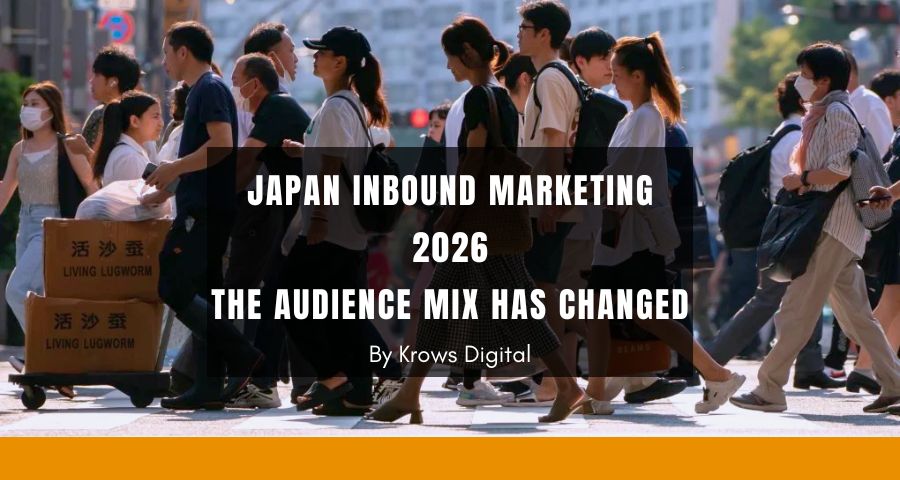
Japan inbound is still one of the biggest growth opportunities for businesses in the Japanese market — but the biggest mistake brands can make in 2026 is treating “inbound” like one audience.
It is not one audience anymore.
If you are a restaurant, retail brand, hotel, clinic, tour business, or real estate company in Japan, your results will depend less on “doing inbound ads” and more on targeting the right country mix, language mix, and funnel stage.
The timing matters. Japan closed 2025 at a record level, with 42,683,600 inbound visitors for the year, and December alone also hit a record for the month at 3,617,700 visitors according to the official JNTO December 2025 visitor release.
At the same time, the latest official JNTO January 2026 release shows 3,597,500 inbound visitors in January, which was down 4.9% year-on-year. That headline alone can make people panic — but the actual takeaway is more useful than that. JNTO explains that timing effects around Lunar New Year (which shifted from late January in 2025 to mid-February in 2026) affected some markets, while demand remained strong in many others, especially due to snow-season travel.
That is exactly why 2026 planning needs a smarter approach: don’t react to one top-line number — read the market mix underneath it.
What changed in the audience mix (and why brands should care)
The strongest inbound strategy in 2026 is not just “more ads.” It is better segmentation.
In the January 2026 JNTO data, some markets still grew strongly, and JNTO highlighted record January performance across multiple countries and regions, including markets in Southeast Asia, North America, and Europe. JNTO also noted that South Korea, Taiwan, and Australia hit single-month records, while 17 markets posted record January levels (including Thailand, Singapore, Indonesia, the Philippines, Vietnam, the U.S., Canada, and more). In other words: even when total inbound dips, many market-specific opportunities are still growing.
This is where many businesses in Japan lose money.
They run one English ad set, one generic landing page, and one broad audience… then conclude that inbound doesn’t convert.
In reality, the issue is usually the strategy:
- Different markets respond to different messages
- Different traveler types have different conversion windows
- Different channels dominate at different moments (discovery vs search vs booking)
- Different locations in Japan require different trust signals
If your business is in Tokyo, Osaka, Kyoto, Hokkaido/Niseko, or another destination-heavy area, your 2026 growth will come from treating inbound as a portfolio of audiences, not a single campaign.
The business case is still huge (and getting more competitive)
The reason this matters so much is simple: the money is there.
According to the official Japan Tourism Agency’s 2025 inbound consumption report, foreign visitor spending reached ¥9.4559 trillion in 2025 (up 16.4% year-on-year), with per-visitor spending at ¥229,000 on average. The same report also shows the top spending markets were China, Taiwan, the United States, South Korea, and Hong Kong.
That creates a very important marketing reality for brands in Japan:
You do not need “everyone.”
You need the right inbound segments for your category.
A luxury hotel, ski property developer, private clinic, or premium restaurant should not optimize the same way as a budget souvenir shop, a chain café, or a tourist-heavy convenience location.
The audience mix is shifting, and the winners in 2026 will be the brands that adjust their targeting and landing pages faster than their competitors.
Who to target now (practical 2026 priority framework)
Here is the framework we recommend for businesses that want inbound leads, bookings, or foot traffic in Japan.
1) Build your 2026 targeting around market clusters, not “international”
A smarter setup is to group by likely behavior and buying power, not just geography.
For example:
Cluster A: High-intent / higher-spend city travelers
Think markets where travelers are often booking premium experiences, better hotels, shopping, and reservations in advance. This cluster is usually strong for businesses in Tokyo, Osaka, and Kyoto.
Cluster B: Seasonal destination travelers
This matters a lot for Hokkaido/Niseko, Hakuba, and other seasonal destinations. Your winter strategy should not look like your spring or summer strategy.
Cluster C: SEA growth audiences
Many Southeast Asian markets are showing strong demand and record levels in JNTO monthly updates. These audiences can be extremely valuable, but they often require better creative localization and clearer booking UX than brands expect.
This one change alone can improve results because it forces your team to stop writing generic ad copy.
2) Match the ad language to the landing-page reality
This is one of the most common inbound mistakes in Japan.
If your ads are in English but the user lands on a page with:
- partial Japanese navigation,
- broken translations,
- no clear booking CTA,
- no map,
- no operating hours,
- no trust signals,
you will lose conversions even if the traffic is good.
For 2026, the basic rule is:
Ad language → landing page language → booking flow language must feel consistent.
That does not mean every business needs 10 languages on day one. It means your highest-priority audiences should get a smooth path.
For many brands, the best practical order is:
- English (clean, conversion-focused)
- Japanese (for local and resident demand)
- One additional high-priority market language if volume justifies it
If your team is still rebuilding SEO visibility (which many brands in Japan are right now), this matters even more because paid traffic becomes your testing engine for what content and messaging actually converts.
3) Use Google for demand capture, not just awareness
For inbound in Japan, Google is still the strongest “intent” channel in most categories because people search when they are ready to decide.
The mistake is using Google only for broad keywords.
The better 2026 play is:
- high-intent search terms,
- location-specific intent,
- “near me” intent,
- category + district searches,
- booking-ready queries,
- and tightly aligned landing pages.
For local businesses, this also means your Google Business Profile and your paid strategy should support each other:
- accurate categories
- strong photos
- clear hours
- booking links
- review momentum
- map-ready landing pages
The ad itself gets the click. The local trust stack gets the conversion.
4) Use Meta and short-form video as your retargeting engine
For most inbound-focused businesses in Japan, Meta (Instagram/Facebook) works best when it is not trying to do everything.
Instead of expecting cold prospecting on Meta to carry your entire pipeline, use it where it performs best:
- retarget site visitors
- retarget video viewers
- retarget users who visited specific pages (menu, booking, room, location, pricing, FAQ)
- show social proof and “what it feels like” creative
This is especially powerful for:
- restaurants
- hospitality
- tourism activities
- premium retail
- real estate showcases
- wellness / beauty / clinics (where compliant)
In practice, the best inbound accounts in Japan usually have one thing in common: they use Google to capture intent, and social to recover and nurture the people who did not convert on the first visit.
5) For Japan-based decision makers, don’t ignore LINE and Yahoo! JAPAN planning
If your business also wants to reach people already in Japan — including resident foreigners, local partners, or Japanese decision makers — your 2026 plan should not be Google + Meta only.
This is where the Japan-specific stack matters.
Depending on your category, LINE and Yahoo! JAPAN inventory (now increasingly planned with convergence in the LY ecosystem) can support:
- awareness campaigns
- retargeting support
- local promotional pushes
- store openings / events
- Japanese-language audience expansion
This is especially relevant if your business is trying to balance inbound demand with local demand, which is exactly what many brands in Japan need right now.
The 2026 inbound ad funnel we recommend (simple version)
If you are a business in Japan and want a realistic inbound pipeline (not vanity metrics), this structure works well:
First, run Google Search to capture active demand. Focus on location-intent and booking-intent queries.
Second, run Meta/Instagram retargeting with short-form creative that shows the real experience: visuals, trust, atmosphere, social proof, and a clear CTA.
Third, make sure your landing pages and booking flow are market-ready. This is where most campaigns fail, not in the ad account.
Fourth, layer in Japan-specific channels (LINE/Yahoo) when you want stronger domestic coverage, local awareness, or support for Japanese audience segments.
Fifth, build reporting that tracks what matters:
- qualified inquiries
- bookings
- calls
- direction clicks / map actions
- lead quality by market
- cost per qualified lead (not just cost per click)
That is how you avoid the classic inbound trap of getting traffic but no business outcome.
Common mistakes we see in inbound campaigns for Japan
Here are the biggest ones:
The first is targeting too broadly. “All countries” sounds efficient, but it usually destroys learning.
The second is poor localization. Even premium brands lose conversions if the page feels unfinished or unclear.
The third is overvaluing impressions. Inbound performance in Japan often comes from a smaller number of highly qualified visitors, not huge reach.
The fourth is no retargeting structure. If someone visits your page and leaves, and your brand disappears, you are wasting paid traffic.
The fifth is measuring the wrong thing. “Traffic” is not the KPI. Qualified inquiries, bookings, and lead quality are.
A practical 90-day plan for 2026
If you want a clean way to start, here is the structure we recommend:
Month 1 is about setup and clarity:
- tracking cleanup
- channel structure
- audience clusters
- landing-page fixes
- baseline reporting
Month 2 is for testing:
- Google keyword themes by market intent
- two or three creative angles on Meta/Instagram
- retargeting by page behavior
- fast feedback on which audience segments actually convert
Month 3 is for scaling:
- increase spend only on winning segments
- localize more deeply where results justify it
- expand channel mix (including LINE/Yahoo if relevant)
- build a stronger content loop from converting topics and FAQs
This approach works because it respects the real shape of 2026 inbound demand in Japan: strong overall opportunity, but with a more complex audience mix than before.
FAQ
Can I run one English campaign for all inbound visitors to Japan?
You can, but it is rarely the best use of budget. In most cases, segmenting by market cluster, intent, and landing-page experience performs better than one broad “international” campaign.
Which channel should I start with for inbound in Japan: Google or Meta?
Start with Google if you need demand capture and qualified inquiries. Add Meta/Instagram retargeting quickly so you can recover users who visited but did not convert on the first session.
Do I need Japanese pages if I mainly target tourists?
Not always on day one. But if you also want local traffic, resident foreigners, or Japanese decision makers, Japanese pages become important very quickly.
What KPI should I track first?
Track qualified inquiries, bookings, calls, and lead quality by market. CPC and traffic are useful, but they are not the business outcome.
Conclusion
Inbound is still huge in Japan — but the 2026 opportunity is no longer just about “getting tourist traffic.”
It is about targeting the right audience mix, building a cleaner funnel, and localizing the conversion experience properly.
If your team is trying to grow in Japan and you want a practical inbound strategy across Google, Meta, and Japan-specific channels, we can help you build the full system — from tracking and audience segmentation to campaign execution and reporting.
At Krows Digital, we help foreign brands and local teams build Japan-specific acquisition systems that convert, not just generate clicks.