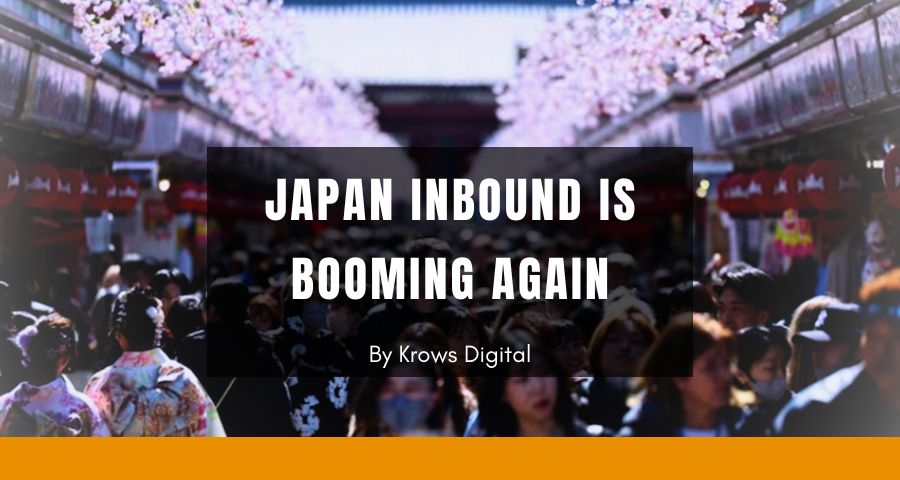
Japan’s inbound tourism rebound is no longer a recovery story. It is a live growth opportunity.
In February 2026, Japan welcomed 3.46 million inbound visitors, the highest February figure on record, according to official data reported by Reuters and released by JNTO. Reuters also noted that Japan ended 2025 at a record 42.7 million inbound visitors, the first time the country moved beyond 40 million annual arrivals.
That matters for more than airlines and hotels. It matters for any company that sells to:
- tourists visiting Japan,
- foreigners already living in Japan,
- or Japanese businesses that want to capture inbound demand.
For Krows Digital, this is exactly the kind of moment that changes channel strategy. When inbound traffic accelerates, the winning brands are not the ones that simply “run more ads.” They are the ones that adapt their language mix, landing pages, local discovery, seasonal content, and conversion paths to how people actually move through Japan.
Why this trend is bigger than a single tourism headline
The February 2026 surge was not a random spike. Reuters reported that the month benefited from the Lunar New Year timing shift into February and strong travel demand from markets such as South Korea and Taiwan, even while arrivals from China were down sharply. South Korea was the largest source market in February at 1.08 million visitors, while arrivals from Taiwan rose to 693,600.
This is important because it changes how brands should think about “foreign customers in Japan.” There is no single inbound audience. A travel-heavy month with more Korean and Taiwanese visitors does not behave the same way as a month driven by US or European tourists. If your media, creative, or landing pages assume “all tourists are the same,” your conversion rate will suffer.
Japan’s own tourism policy direction also reinforces that this is not a short-term anomaly. The Japan Tourism Agency’s Tourism Nation Promotion Basic Plan explicitly centers three themes: sustainable tourism, increased tourism consumption, and regional attraction, with a target of ¥200,000 in tourism consumption per international visitor by 2025.
In other words: Japan is not just trying to bring more people in. It wants visitors to spend more, travel more broadly, and engage more deeply. That creates opportunities far beyond hotels and airport transfers.
What types of businesses should care most
The obvious winners are hospitality, retail, tours, food and beverage, and transport. But the real opportunity is wider.
If your business sells any of the following, this rebound matters:
- beauty and wellness services,
- luxury goods,
- tax-free retail,
- real estate or relocation services for foreigners,
- education and language services,
- restaurants and cafés,
- culture, events, and experience-based businesses,
- travel-friendly ecommerce offers,
- or any local business in Tokyo, Osaka, Kyoto, Fukuoka, Niseko, or other high-traffic inbound areas.
And there is a second layer. Not all demand will convert while the visitor is still traveling. Some people will discover a brand in Japan, follow it, compare later, and purchase after they return home. That means your remarketing and retention systems matter just as much as your top-of-funnel visibility.
The biggest marketing mistake brands make during an inbound boom
Most companies react to rising inbound demand by doing one of two things:
- translating a few pages into English, or
- increasing ad spend without changing the conversion path.
Neither is enough.
The real shift should be structural:
- your discovery channels need to match traveler behavior,
- your content needs to answer “what is this and why should I trust it” fast,
- and your landing pages need to remove friction for people who are short on time, unfamiliar with local systems, and often using mobile on the go.
A traveler in Tokyo making a decision from a smartphone is not browsing like a relaxed desktop shopper at home. They are verifying quickly, scanning for proof, looking for maps, transport cues, payment confidence, booking clarity, and immediate relevance.
That means your Japan inbound funnel should be designed around trust + speed + context.
What foreign brands should change now
1) Rebuild your language strategy around real inbound markets
“English only” is often not enough.
If the strongest inbound demand right now is coming from Korea and Taiwan, then brands in high-inbound categories should at least review whether their funnel needs:
- English as the default international layer,
- simplified multilingual support on key pages,
- or paid campaigns segmented by source market.
This does not mean translating the entire website into five languages overnight. It means being strategic:
- top landing pages,
- booking pages,
- FAQs,
- store access pages,
- refund / delivery / support information,
- and high-intent paid campaigns.
For many businesses, just translating the highest-friction parts of the funnel can lift performance more than launching entirely new campaigns.
2) Treat Google Maps, local search, and store information as performance channels
When inbound traffic rises, local intent rises with it.
Tourists search things like:
- “best sake bar near Ginza”
- “tax free skincare Tokyo”
- “private tour Shibuya English”
- “luxury omakase foreign friendly”
- “Niseko property viewing English”
If your Google Business Profile, local landing pages, and store information are weak, you are invisible at the moment of highest intent.
For businesses with physical presence or city-specific demand, local SEO is not optional during an inbound spike. It becomes one of the cheapest ways to capture demand that is already in Japan.
3) Build landing pages for “visitors in motion,” not just regular customers
A high-performing inbound landing page should answer the following immediately:
- what this is,
- where it is,
- who it is for,
- how to get there or book,
- whether it supports foreign customers,
- how payment works,
- and why it is worth the time.
For retail or hospitality, the page also needs:
- opening hours,
- station access,
- map clarity,
- reservation steps,
- cancellation rules,
- multilingual support cues,
- and proof such as reviews, media, or known partners.
This is especially important because Japan buyers, including inbound buyers, still verify heavily before acting. When time is short, trust must appear faster.
4) Use paid media to capture “travel intent,” not just brand awareness
If inbound is rising, the strongest paid media opportunities are often:
- search ads on intent-heavy queries,
- Meta or TikTok content that makes the location or experience instantly understandable,
- and retargeting that follows up after the first discovery.
The creative itself should change too.
For foreign visitors in Japan, winning creative often includes:
- exact location context,
- proof of ease (“5 minutes from Shibuya Station”),
- foreigner-friendly reassurance,
- social proof,
- and a very clear next step.
The ad should not assume local knowledge. It should reduce hesitation.
5) Don’t forget the “foreigners living in Japan” segment
This is where many brands miss easy wins.
An inbound boom creates more competition for tourists, but it also increases visibility among foreigners who are already based in Japan. That audience often converts better because:
- they understand the environment,
- they may have higher purchasing confidence,
- and they are more likely to repeat or recommend.
For brands targeting foreigners in Japan, a good strategy is to split messaging between:
- “visit now while in Japan” behavior,
- and “life in Japan” behavior.
Those are not the same funnel.
A tourist wants immediacy and convenience. An expat or long-term resident wants reliability, repeatability, and value over time.
Where the opportunity is strongest in 2026
Based on the rebound and policy direction, several business angles look especially promising right now:
Retail and tax-free shopping
As inbound traffic grows, stores that clearly communicate tax-free availability, product uniqueness, and easy purchase steps should outperform generic retail pages. This is especially true in beauty, wellness, gifting, and luxury.
Hospitality and food
Restaurants, premium bars, tea experiences, and chef-led venues can benefit by pairing local search, short-form content, and easy multilingual booking paths.
Tours and experiences
The “what should I do in Japan” category becomes more competitive as visitor volumes rise. Operators that position around niche, premium, or insider experiences can stand out more than broad “Tokyo tour” offerings.
Real estate and relocation
A surge in visitors also creates long-tail demand from people exploring Japan as a place to invest, relocate, or spend more time. This is especially relevant for areas such as Niseko and high-end Tokyo neighborhoods.
Ecommerce with Japan demand spillover
Some brands will first be discovered by people while they are in Japan, then purchased later from abroad. That means email capture, retargeting, and international shipping information can become part of the inbound funnel.
The practical 30-day playbook
If we were advising a brand to act on this trend right now, the first 30 days would look like this:
Week 1
- Audit all high-intent pages
- Fix language and trust gaps
- Update Google Business/Profile information
- Review local search visibility and city pages
Week 2
- Launch or refine inbound-focused paid search campaigns
- Build or update retargeting audiences
- Create 3 to 5 short-form assets focused on location, clarity, and proof
Week 3
- Segment by source market where useful
- Review top-performing queries and landing pages
- Add FAQ and conversion-friction fixes
Week 4
- Scale the best combinations
- Build retention flows for visitors who do not convert immediately
- Prepare a second wave of creative around seasonality and events
This is how inbound momentum becomes revenue, not just website traffic.
What this means for Krows Digital’s clients
The real lesson is simple:
Japan’s inbound boom is not just a tourism story. It is a demand-shift story.
If more foreigners are in Japan, then more search, social, local discovery, and cross-border consideration is happening right now. That changes how brands should:
- structure campaigns,
- write landing pages,
- prioritize localization,
- and measure conversion paths.
For foreign companies entering Japan, this is a timing advantage. The brands that adapt fastest can win visibility while slower competitors are still treating inbound as a generic audience.
For companies already targeting foreigners in Japan, this is the moment to refine your funnel and message to capture more of the demand that is already arriving.
Contact Krows Digital
If your business wants to capture more foreign demand in Japan, we can help you build the right mix of:
- inbound-focused paid search and social,
- multilingual high-intent landing pages,
- local SEO and trust optimization,
- and reporting that focuses on qualified leads and real revenue impact.
Contact Krows Digital and we’ll map a practical Japan inbound growth plan for your category.
ready to take your business to the next level?
Get in touch today and receive a complimentary consultation.
FAQ
Why is Japan’s inbound rebound such a big marketing topic in 2026?
Because Japan recorded a record 3.46 million visitors in February 2026, and 2025 already finished at 42.7 million annual inbound visitors, showing this is not a one-off spike but a major demand environment for brands.
What kinds of businesses benefit most from the inbound surge?
Hospitality, retail, food and beverage, tours, beauty, luxury, real estate, education, and any service or product aimed at foreign visitors or foreigners living in Japan.
Should brands translate everything into multiple languages?
Not necessarily. The best first step is translating the most conversion-critical pages and aligning content to the actual inbound markets driving demand right now.
Is local SEO really that important for inbound demand?
Yes. For many travelers, local search and Maps are the highest-intent discovery channels once they are already in Japan.
What should brands do first?
Audit landing pages, strengthen local search visibility, fix trust and booking friction, and launch paid campaigns aligned to real inbound intent.